"What Will People Say?" Four Inherited Frames That Keep Us Stuck
Sadeed Mirza · 5 November 2026
Every family has an invisible member who never comes to dinner but decides everything.
Log.
As in, log kya kahenge. What will people say.
Log decided which subject you took in intermediate. Log had views on your marriage, your job, your weight and the colour of your living room. Log have never once paid a bill, and somehow they hold a veto.
In HOPE I call this a frame. A frame is a meaning we were handed before we could check it, which then quietly shapes every choice that follows. Our culture gives us some beautiful frames. It also gives us a few that keep good people stuck for decades.
Here are four of the most common, and what to do with them.
1. The People Frame: "What will people say?"
This one turns life into a performance for an audience that is mostly not watching.
Here is the dry truth I have seen many times. When people finally make the decision they were afraid of, the audience they were performing for barely notices. Everyone is busy with their own life, their own children, their own log. Years can be spent protecting a reputation with an audience that was never really in the room.
The Islamic correction is clean. There is one audience whose opinion counts. Ihsan, the Prophet's definition of excellence, is to worship Allah as though you see Him, and if you do not see Him, knowing that He sees you (Sahih Muslim 8). When that becomes the audience, log shrink to their proper size.
2. The Sacrifice Frame: "Good people give up their happiness for others"
This frame is especially strong in South Asian homes, and it starts from something noble. Families do need sacrifice. Parents do give things up. That is real and it deserves honour.
The trouble starts when sacrifice becomes an identity. Then it curdles. The person who gave everything up begins to keep score, and the gift slowly turns into a debt that everyone around them is expected to repay. Nobody enjoys being loved that way, including the person doing the loving.
Healthy sacrifice is chosen, clear and complete. It is given for Allah's sake and then let go. A sacrifice you keep reminding people of was never fully given.
3. The Fate Frame: "It's written. Nothing can change."
This one hides inside religious language, which makes it hard to question. Of course Allah has decreed all things. But the same Quran says: "Indeed, Allah will not change the condition of a people until they change what is within themselves" (Quran 13:11).
When Umar ibn al-Khattab turned his army away from a plague-struck land, someone asked whether he was running from Allah's decree. He said he was moving from Allah's decree to Allah's decree (Sahih al-Bukhari 5729). Choosing the fertile valley over the barren one was also part of the qadr.
Naseeb was never meant to be a sleeping pill. It was meant to free us from anxiety about outcomes while we do our part fully.
4. The Competition Frame: "Life is about being better than others"
This frame turns every family gathering into a scoreboard. Whose son got into which university. Whose daughter married where. Whose house has the bigger gate.
The cost is quiet and steep. You can win the competition and lose the closeness, because it is hard to be near someone you are always measuring yourself against. Siblings who could have been friends become rivals with good manners.
The Prophet, peace be upon him, gave a better measure. "None of you truly believes until he loves for his brother what he loves for himself" (Sahih al-Bukhari 13). That one sentence ends the scoreboard.
How to tell a frame from the truth
A frame feels like reality from the inside. You cannot read the label from inside the jar. So bring it out where you can see it.
Say the sentence out loud
Write down the exact sentence that is running the decision. "People will think I failed." "A good daughter would not." "It is not in my naseeb." Seen on paper, many of these sound much smaller.
Ask whose voice it is
Very often it belongs to a particular aunt, a teacher, a grandparent, a version of your father at forty. Respect them. Then notice that they are not the one who has to live your life.
Check it against the deen, not the culture
Culture and deen overlap a great deal, and where they differ, the deen wins. Some frames we treat as Islamic are simply habits of a region and a generation.
Choose the meaning on purpose
You will always be living inside some frame. The question is whether you chose it.
Questions people ask
Is caring about what people say always wrong?
No. Reputation matters, and Islam values dignity and good character in public. The problem is when other people's imagined opinions replace your own conscience and your accountability to Allah.
Where do these frames come from?
Mostly from childhood, from family and community habits absorbed long before we could question them. That is why they feel so true.
Where can I go deeper?
Reframing is the R of the HEART framework in my book HOPE: The Heart of Personal Excellence, available on Amazon. Heal Before You Build explains the full framework.
Where to begin
If you want a clear read on where you stand, try the free Readiness Audit. Five honest questions, a few minutes.
Log will say something.
Log always do.
Live anyway.
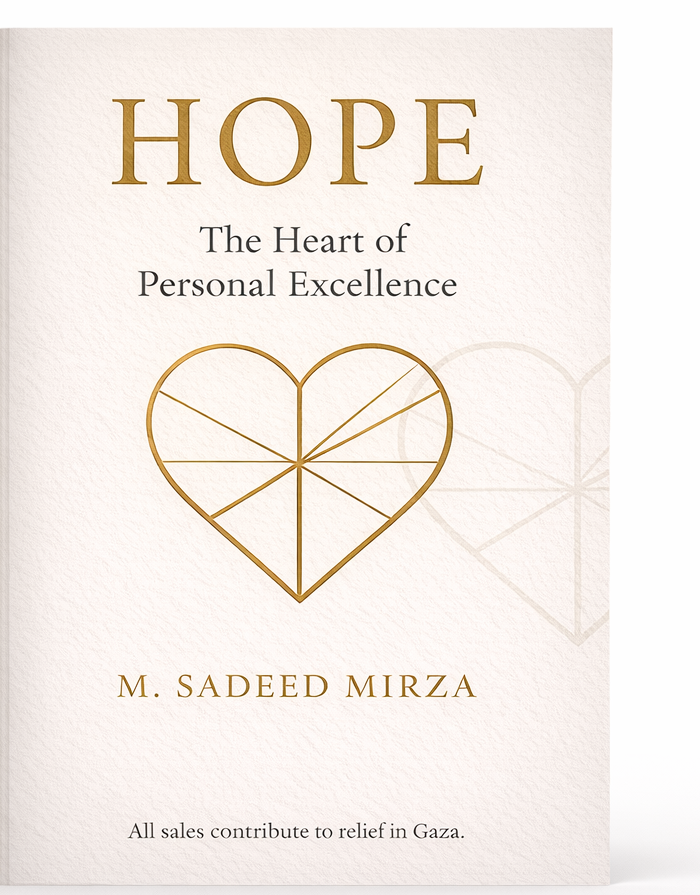
Get HOPE. free book + coaching insights
Subscribe and I'll send you a free PDF of my book HOPE, plus occasional, genuinely useful notes on coaching, counseling and hypnosis, and first word on new CCH+ cohorts across the GCC.