Tie Your Camel: Qadr, Effort and the Trap of "It's My Naseeb"
Sadeed Mirza · 16 November 2026
In 2003 I was standing at the side of a road in Kuala Lumpur.
My car had broken down. Again. I had fifty ringgit to last me two weeks. The tropical rain was starting, and so was the familiar spiral. Why does this always happen to me. Other people have reliable cars. Other people have savings. Other people.
Then, standing there getting wet, a different question arrived. What if this is exactly what needs to happen for who I am becoming.
I started laughing. Soaking, nearly broke, laughing like a madman on the hard shoulder. Because I suddenly saw it. I had been writing a victim's story about my own life without noticing I was the one holding the pen.
The car did not fix itself. No money appeared. But that night I stopped waiting for a rescue and started looking for what I could actually do. I called a friend who needed design work. I offered to teach English. Doors appeared that had been there all along, hidden behind my complaint.
The question that confuses so many of us
In almost every workshop someone asks it, sincerely. "If everything is already written, how can I take responsibility?"
It is a real question and it deserves a real answer, because the wrong answer has kept a lot of good people sitting still. "It is my naseeb to struggle." "It is written that I will be poor." Said with a sigh, and then nothing changes.
That is not tawakkul. It is a kind of spiritual tiredness dressed up as acceptance.
What is decreed, and what is ours
In HOPE I draw a simple line.
What is already decreed, to accept with rida
When and where you were born. Your family. Your body and its limits. Other people's choices. The events that genuinely sit outside your control. The day you will die.
What is ours to answer for
Your response to all of the above. Your effort and your choices. Your character. How you spend your time. The meanings you build out of what happens. And your du'a.
A simple picture helps. Allah has decreed that gravity exists. Whether you jump off a roof or climb down the stairs is still your choice inside that decree. You cannot argue with gravity. You can work with it wisely.
Three anchors from the Sunnah
Tie the camel
A man asked the Prophet, peace be upon him, whether he should tie his camel and trust Allah, or leave it untied and trust Allah. He said, "Tie it, and rely upon Allah" (Jami at-Tirmidhi 2517). Effort and trust were never rivals. They were always meant to travel together.
From decree to decree
When Umar ibn al-Khattab turned his army back from a land struck by plague, someone challenged him: was he fleeing from Allah's decree? He answered that he was moving from Allah's decree to Allah's decree, like a shepherd choosing the green side of a valley over the barren side (Sahih al-Bukhari 5729). Wise action is part of qadr, not a rebellion against it.
Du'a is part of the plan
The Prophet said, "Nothing averts the decree except du'a" (Jami at-Tirmidhi 2139). Your du'a was known and written too. Asking is one of the ways the decree unfolds.
Why learned helplessness feels so safe
Psychology has a name for giving up after repeated defeat: learned helplessness, first studied by Martin Seligman in the 1960s. What makes it so sticky in people is that it pays. Quietly.
If nothing is my responsibility, nothing is my failure. If I am powerless, I collect sympathy instead of demands. And if trying is pointless, I never have to face the uncertainty of trying. The certainty of "it will not work" can feel more comfortable than the risk of "it might".
Seeing those payoffs clearly is often the moment things begin to move.
A practice for this week
Each night, before sleep, ask three questions.
- Where did I wait for rescue today?
- Where did I take my part fully?
- What is one thing within my control that I will do tomorrow?
Then make du'a for the outcome and hand it over. Work as if it depends on you. Pray knowing it depends on Him.
Oont baandho. Phir bharosa karo.
Questions people ask
Doesn't taking responsibility contradict tawakkul?
No. The Prophet joined them in one sentence: tie it, and rely upon Allah. Tawakkul is trust in Allah after you have done your part, not instead of it.
What about things I truly cannot change?
Those call for rida and sabr, contentment and patience. Responsibility then means owning your response to them, which is always yours.
Where is this in HOPE?
This is the E of the HEART framework, Empower, grounded in khilafah, our role as stewards. HOPE: The Heart of Personal Excellence is available on Amazon.
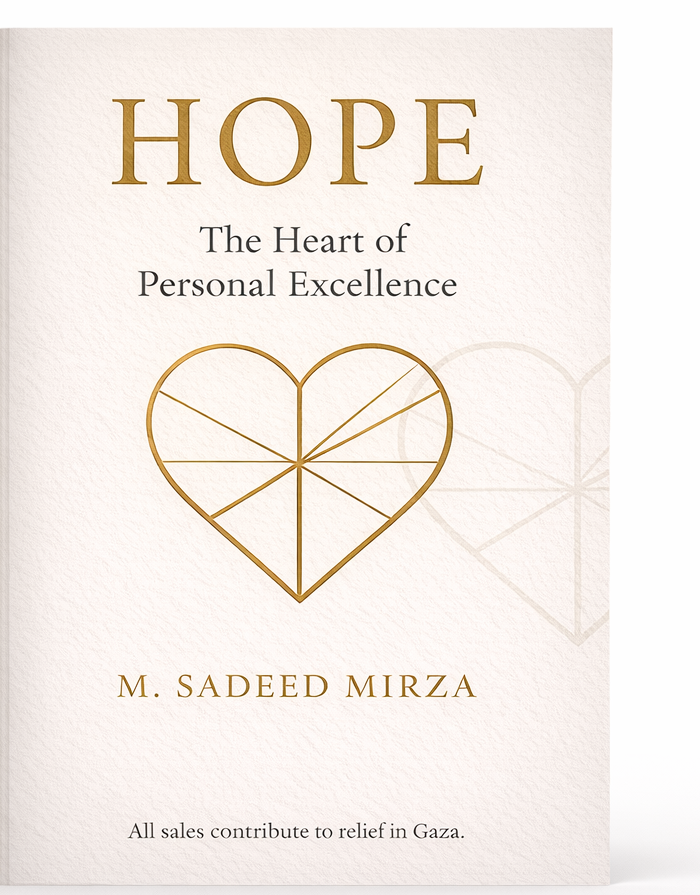
HOPE: The Heart of Personal Excellence
The HEART framework, in full: Heal, Empower, Align, Reframe, Transform.
Or get the free PDFWhere to begin
To see clearly where you stand, try the free Readiness Audit. Five honest questions, a few minutes.
The rain was not the point.
The pen was.
Pick it up.
Get HOPE. free book + coaching insights
Subscribe and I'll send you a free PDF of my book HOPE, plus occasional, genuinely useful notes on coaching, counseling and hypnosis, and first word on new CCH+ cohorts across the GCC.