Clean Pain and Dirty Pain: How Healing and Forgiveness Actually Work
Sadeed Mirza · 9 November 2026
For four years I carried a stone on my heart.
In Urdu we have a phrase for it. Dil pe patthar rakh kar jeena. Living with a stone placed on your heart. That was exactly how it felt. And the irony was not lost on me. I was the one on the stage helping other people through their limits, while privately I could not move my own.
What finally moved it was not more information. I already knew plenty. It was understanding the difference between two kinds of pain.
The broken glass that was never there
In 1974 the psychologists Elizabeth Loftus and John Palmer showed people film of a car accident. Afterwards some were asked how fast the cars were going when they "hit" each other. Others were asked how fast they were going when they "smashed" into each other.
A week later, the "smashed" group were much more likely to remember seeing broken glass.
There was no broken glass in the film.
One word added a detail that never happened, and memory accepted it as fact. We all do this with our wounds. Something real happens. Then we add the broken glass.
Clean pain and dirty pain
Clean pain is what actually happened. The loss. The betrayal. The words that were said.
Dirty pain is what we add. The story. The shame. The sentence that turns a wound into a worldview. "This happened because I am unlovable." "I should have known." "Nobody can be trusted."
The Quran gives us a model of clean pain in the words of Prophet Ayyub, peace be upon him. He lost his wealth, his children and his health. His prayer was this: "Indeed, adversity has touched me, and You are the Most Merciful of the merciful" (Quran 21:83).
He named the pain honestly. He did not add a story of victimhood. No "why me". No verdict on his own worth. Clean pain, held inside trust in Allah's mercy.
Prophet Yaqub, peace be upon him, wept for Yusuf until his sight failed, and said: "I only complain of my suffering and my grief to Allah" (Quran 12:86). Grief, fully felt, directed to the right address.
Clean pain hurts. Dirty pain hurts and keeps hurting, because we keep retelling it.
The wound behind the wound
Very often the thing a person brings is not the real thing. A small rejection at work produces a reaction far bigger than the event. The present moment is touching an older bruise.
In HOPE I call this the wound behind the wound. Healing the surface problem without finding it is like painting over damp. It looks better for a season.
What forgiveness does and does not require
Forgiveness in Islam is a mercy we give, and it is also a protection for our own hearts against the slow poison of resentment. "But whoever pardons and makes reconciliation, his reward is due from Allah" (Quran 42:40).
In HOPE I set out forgiveness as a sequence, and the order matters.
- Feel the injury fully. Rushing to forgive what you have not let yourself feel is bypassing, and it does not hold.
- Name what was lost. Trust, time, innocence, money, peace. Be specific. What was taken matters.
- Separate the person from the act. They are more than their worst moment. This does not excuse the act. It places it.
- Choose your peace over their punishment. Forgiveness frees you. Their change is not required for your freedom.
- Release again, as often as needed. Some wounds ask to be forgiven many times. Each time the memory stings, choose release again.
Just as important is what forgiveness does not require. It does not require reconciliation. It does not require forgetting. It does not require pretending the act was acceptable. And it does not require trusting someone again before they have earned it. Forgiveness and foolishness are different things.
The Prophet, peace be upon him, showed the strength in it. "The strong person is not the one who overcomes people by his strength. The strong person is the one who controls himself when angry" (Sahih al-Bukhari 6114). On the day Makkah opened to him, facing people who had hurt him for years, he chose mercy.
A practice for when the old pain rises
When a feeling surges, try separating the clean from the dirty.
- Let the feeling be there without the story for a minute or two. Feel it in the body. Breathe into it.
- Notice the sentence that wants to attach itself. Write it down.
- Ask: is this what happened, or what I added?
- Say the du'a the Prophet taught for affliction: Allahumma ajirni fi musibati wa akhlif li khayran minha. O Allah, reward me in my affliction and replace it with something better (Sahih Muslim 918).
Questions people ask
Can I forgive someone and still keep my distance?
Yes. Forgiveness is a matter of the heart. Reconciliation is a separate decision and depends on safety and change.
What if the pain is too much to manage alone?
Please speak to a qualified professional. Some wounds need clinical care, and seeking it is a strength. HOPE says so plainly on its first pages, and so do I.
Where is this in HOPE?
Healing is the H of the HEART framework, Shifa-e-Aadil, complete and just healing. HOPE: The Heart of Personal Excellence is available on Amazon.
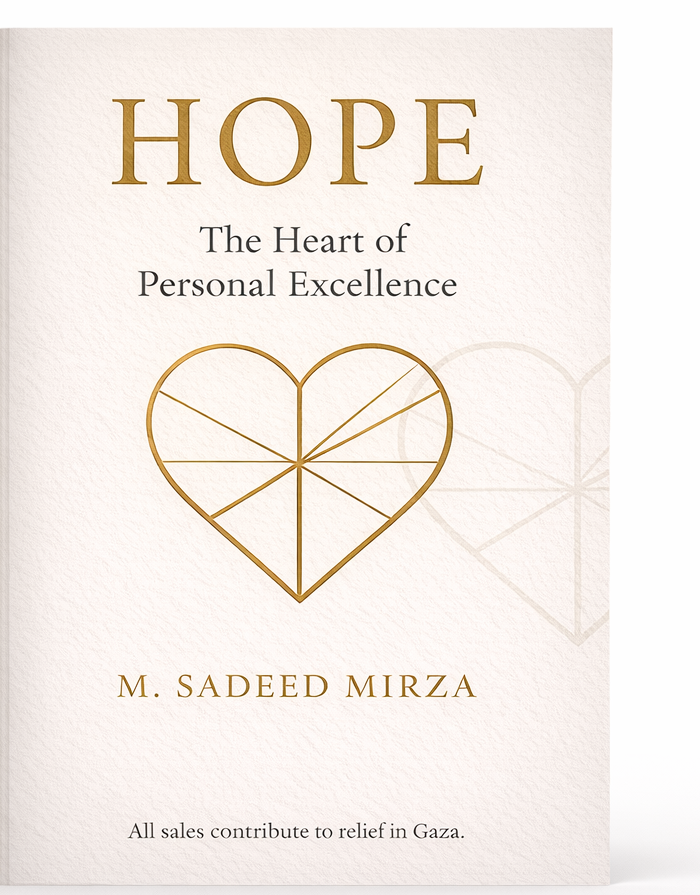
HOPE: The Heart of Personal Excellence
The HEART framework, in full: Heal, Empower, Align, Reframe, Transform.
Or get the free PDFWhere to begin
If you are drawn to helping others carry their stones, the CCH+ programmes teach coaching and counseling as one practice. Start with the free Readiness Audit, or see the Programs page.
The pain was real.
The glass was not.
Sweep it up.
Get HOPE. free book + coaching insights
Subscribe and I'll send you a free PDF of my book HOPE, plus occasional, genuinely useful notes on coaching, counseling and hypnosis, and first word on new CCH+ cohorts across the GCC.